Assign and validate the highest-impact barrier.
COREaccess™ — Step 2
Overlays Don't Fix Accessibility. Code Fixes Do.
Accessibility widgets and overlays are marketed as a quick fix. They don't work. Courts have repeatedly ruled against businesses that relied on them. Real remediation means fixing the underlying code, whether your team does it with our guidance or Bixli handles the implementation. That's the only path forward.
When the fix has to hold up
Standards-Based Fixes, Start to Finish
Every remediation follows your audit report. We address issues in severity order (highest legal risk first) and validate each fix against WCAG 2.1 AA before closing it.
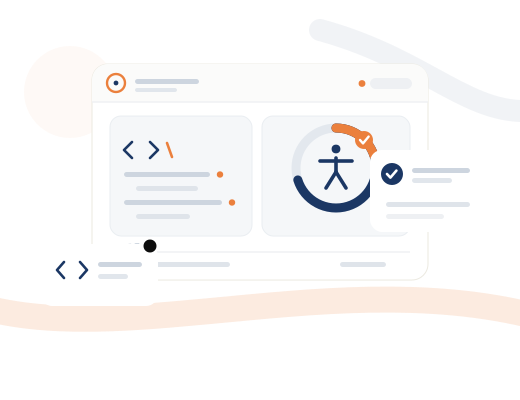
We fix issues at the source: semantic HTML, ARIA roles, keyboard interaction patterns, color contrast, form labeling, focus management, and more. No patches on top of broken code.
COREaccess transformation map
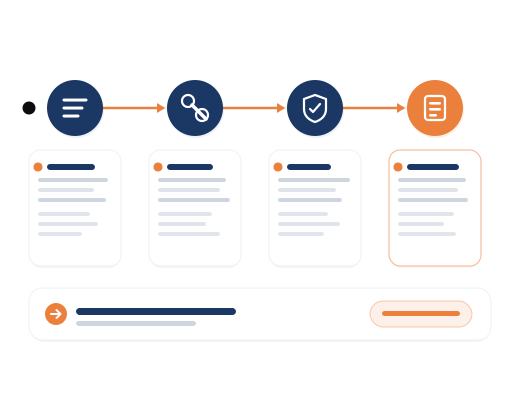
From barrier to owner to verification
Current pressure
Findings exist, but fixes do not move
- Unassigned barriers
Audit issues are known but not connected to an owner.
- Mixed severity
High-impact blockers sit beside lower-risk cleanup.
- No validation loop
The team cannot confirm whether a fix resolved the user problem.
Bixli lens
Each barrier is mapped to ownership, fix path, and verification
Who can change it?What proves it is fixed?Does the user path work now?
Decision threshold
The remediation queue is ordered by impact and ownership
Adaptive path
Supports are chosen for accountable remediation
Assign design, content, code, or platform responsibility.
Retest the affected interaction after remediation.
Hold until recurring ownership gaps are visible.
Better operating state
Accessibility fixes become accountable and verifiable
- Clear owner
Every priority finding has an accountable path.
- Verified fix
Remediation is checked against the original user impact.
- Operational gain
Accessibility work moves through a repeatable queue instead of stalling after audit.
Less ambiguity about who needs to act and what completion actually means.
Findings become trackable work with ownership, priority, and validation.
When ownership has to match capacity
We Work the Way Your Team Works
Done-for-You
Bixli handles every fix. You review and approve. Ideal when your team lacks the bandwidth or expertise to execute independently.
Done-with-You
We work alongside your developers, guiding the implementation and validating each fix. Builds internal capability while getting the work done.
Guidance Only
Your team does the work with our remediation roadmap and expert Q&A support. Best for in-house teams that want to own the process.
Findings turned into ownership
What remediation changes operationally
Remediation turns audit findings into tracked fixes. The work is not a widget or a vague recommendation list; it is a standards-based queue of code, content, and interaction updates that can be assigned and verified.
When known barriers still need a path through the team
The barrier was known. The fix needed ownership.
After the audit, the practice could see the problems: form labels, focus states, contrast, and a few interactions that did not work cleanly by keyboard. What was missing was ownership. Remediation turned the findings into a prioritized queue, clarified who would fix each item, and kept validation tied to the original WCAG issue.
- Findings become remediation tasks with clear ownership.
- High-severity barriers are addressed before lower-risk cleanup.
- Fixes are validated against the original accessibility issue.
- The team gains a maintainable record of what changed and why.

Ready to Fix It
Start Your Remediation Plan
You have the audit. Now fix it right. Tell us your timeline and what your team can handle; we'll scope a remediation plan that fits.