You Can't Fix What You Don't Know Is Broken
Most businesses assume their website is accessible. Most are wrong. A proper audit doesn't just run a scanner. It combines automated tools with manual expert testing to find the barriers that automated scans miss entirely.
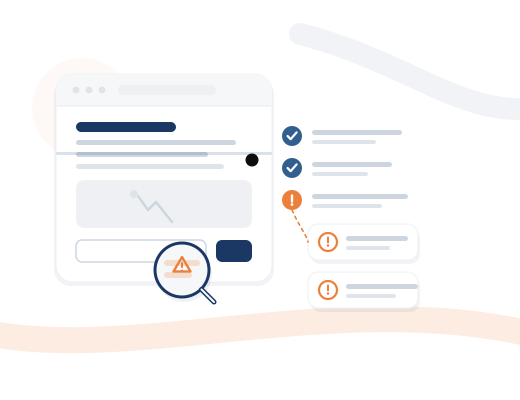
When the scan is not enough
A Two-Layer Audit Process
Automated scanners catch roughly 30% of accessibility issues. The rest require a trained human. Our audit uses both.
- Automated scan — site-wide crawl using industry-standard tools, flagging WCAG violations at scale
- Manual testing — keyboard-only navigation, screen reader review (NVDA, VoiceOver), focus management, and color contrast verification
- WCAG 2.1 AA mapping — every issue traced to a specific success criterion with severity rating
- Legal risk assessment — issues ranked by likelihood of triggering ADA litigation or EAA enforcement
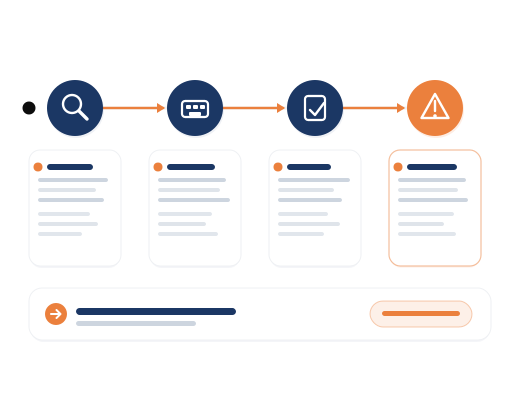
What your team can act on
A Report You Can Actually Use
No spreadsheet dumps. No raw scanner output. A clear deliverable your team or ours can execute against immediately.
- A prioritized list of every accessibility barrier on your site, ranked by severity and legal risk
- WCAG 2.1 AA gap analysis mapped to specific pages and components
- Keyboard navigation and screen reader findings from manual expert testing
- A clear remediation roadmap in plain English. No jargon, no filler
- A baseline record you can reference for ongoing compliance tracking
Risk made visible
What the audit makes concrete
An audit turns accessibility uncertainty into assignable evidence: the WCAG criterion, the affected interaction, the user impact, the severity, and the remediation path.
The team needed findings they could act on.
A behavioral health practice had already heard enough about accessibility to feel exposed, but the scan results did not tell the team what a patient would actually run into. The audit tied the risk to real interactions: intake forms, keyboard movement, screen reader labels, contrast, severity, and the fixes that needed to happen first.
- Scanner output is separated from manually confirmed barriers.
- Each finding is mapped to a WCAG criterion and user impact.
- Severity helps the team decide what to fix first.
- The report becomes the baseline for future remediation and monitoring.

Get Your Accessibility Audit
Schedule a 15-minute consultation to discuss your site, your risk exposure, and what a Bixli audit covers for your specific situation.